
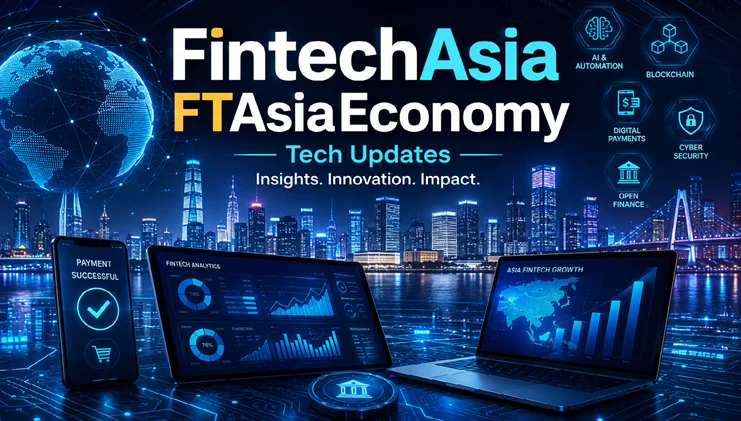
The latest FTAsiaEconomy Ftasiaeconomy Tech Updates focus on major technology themes affecting Asia, including artificial intelligence, digital payments, 5G, fintech, cybersecurity, automation, and green technology. FTAsiaEconomy content presents these areas as important parts of Asia’s changing digital economy, while reports from organizations such as the Asian Development Bank, IMF, and GSMA provide independent evidence about the wider regional trends.
What Do FTAsiaEconomy Ftasiaeconomy Tech Updates Cover?
FTAsiaEconomy Ftasiaeconomy Tech Updates technology content covers several areas of digital transformation. Its published material discusses artificial intelligence, automation, fintech, digital payments, 5G, cybersecurity, blockchain, green technology, smart cities, and other emerging technologies. The site’s broader technology coverage also connects innovation with business, finance, and economic development.
Artificial intelligence is one of the central themes. FTAsiaEconomy Ftasiaeconomy Tech Updates describes AI applications across areas such as customer service, healthcare, manufacturing, analytics, and automation. This direction is consistent with current regional research. The Asian Development Bank’s 2026 outlook examines AI readiness across Asia and the Pacific and notes that differences in digital infrastructure, skills, innovation capacity, institutions, and data governance affect how quickly economies can benefit from AI.
Connectivity is another important part of the technology picture. FTAsiaEconomy Ftasiaeconomy Tech Updates discusses 5G as an enabler of faster communications and connected devices. The GSMA’s 2026 Asia Pacific report says the region could reach 1.5 billion 5G connections by 2030, while mobile technologies and services contributed about $1 trillion to the Asia Pacific economy in 2025.
Digital finance is also closely connected with these updates. FTAsiaEconomy Ftasiaeconomy Tech Updates discusses mobile banking, digital payments, online financial services, and fintech innovation. Independent IMF research confirms that ASEAN economies have made substantial progress in domestic and cross-border digital payments, with digitalization supporting faster and more efficient payment systems while also creating new financial-sector challenges.
Which Technology Trends Matter Most in Asia?
AI and automation are among the most significant developments. The Asian Development Bank’s 2026 research indicates that generative AI could increase productivity and transform work, although countries have different levels of readiness. Advanced economies generally have stronger digital infrastructure, skills, innovation systems, and institutional capacity, while many developing economies still face constraints in computing resources, skills, and data governance.
The next major area is 5G and mobile connectivity. According to the GSMA, AI is increasingly becoming integrated with mobile networks and digital infrastructure. The organization projects that mobile technologies and services could contribute $1.4 trillion to the Asia Pacific economy by 2030, up from approximately $1 trillion in 2025. The report also highlights digital trust, resilient infrastructure, and digital sovereignty as important issues for the region.

Digital payments are another major trend. Faster payment networks, mobile wallets, cross-border payment connections, and digital banking are changing how consumers and businesses transfer money. IMF research on ASEAN describes digital payments as an important part of regional financial integration and notes their potential to reduce transaction friction and support e-commerce and smaller businesses.
For readers looking for broader regional context, the Asian Development Bank’s 2026 economic outlook provides independent information on Asia’s economic and technology environment.
Cybersecurity is becoming increasingly important as digital adoption grows. The GSMA identifies digital trust as a strategic priority because expanding digital services can also increase exposure to scams and other security risks. ADB’s digital strategy likewise emphasizes cybersecurity, privacy, data governance, and responsible use of artificial intelligence.
Green technology is another recurring theme in FTAsiaEconomy Ftasiaeconomy Tech Updates content. Its articles discuss renewable energy, electric vehicles, and energy-efficient infrastructure as examples of technology connected with sustainability. These developments are part of a broader transition in which digital innovation and environmental objectives increasingly overlap.
How Are These Updates Affecting Businesses and the Economy?
The impact extends beyond the technology industry itself. AI can automate repetitive processes and support data analysis, while cloud computing allows organizations to scale digital operations. Digital payments can reduce friction in transactions, and improved connectivity can help businesses reach customers across geographic boundaries.
The economic significance is particularly important in Asia because technology is increasingly connected with trade, manufacturing, finance, and services. ADB’s 2026 research on regional integration identifies rapid digital growth and opportunities from artificial intelligence as factors supporting investment and economic integration.
At the same time, technology does not automatically produce equal benefits everywhere. ADB’s research points to differences in infrastructure, human capital, innovation capacity, and data governance. These differences can affect how quickly businesses and workers can adopt new systems.
There are also wider economic pressures to consider. ADB’s July 2026 outlook projects 4.9% growth for developing Asia and the Pacific in 2026, down from 5.5% in 2025, while forecasting regional inflation of 4.3%. The organization identifies energy-market uncertainty, trade-policy uncertainty, financial conditions, and other risks alongside technology-related developments.
Another emerging issue is AI-powered financial activity. An IMF 2026 note examines agentic AI, in which AI systems can perform tasks on behalf of users with limited human input. In payments, this could change how transactions are initiated and managed, but the IMF also identifies questions involving cybersecurity, transparency, authorization, compliance, and legal uncertainty.
For businesses, the practical lesson is that technology updates should be viewed together rather than separately. AI depends on computing and connectivity, digital finance depends on secure infrastructure, and wider adoption depends on skills, regulation, privacy, and trust.
Read About: Zopalno Number Flight
Fazit What Should Readers Know About FTAsiaEconomy Ftasiaeconomy Tech Updates?
FTAsiaEconomy Ftasiaeconomy Tech Updates mainly refer to technology developments discussed around FTAsiaEconomy’s coverage of Asia’s digital economy. Key subjects include AI, automation, fintech, digital payments, 5G, cybersecurity, blockchain, and green technology.
Independent sources support the importance of many of these themes. ADB highlights AI readiness and digital infrastructure, the IMF examines digital payments and emerging AI applications in finance, and GSMA reports rapid growth in 5G, mobile technology, and AI integration across Asia Pacific.
FAQs
What are FTAsiaEconomy Ftasiaeconomy Tech Updates?
They are a search term associated with FTAsiaEconomy Ftasiaeconomy Tech Updates coverage of technology and economic developments, particularly AI, fintech, digital payments, 5G, cybersecurity, and emerging technologies.
Does FTAsiaEconomy cover artificial intelligence?
Yes. Its technology content discusses AI, automation, analytics, healthcare applications, customer service, and other uses of artificial intelligence.
Why is 5G important in Asia?
5G provides high-speed connectivity and supports connected devices, industrial applications, and AI-related services. GSMA projects 1.5 billion 5G connections across Asia Pacific by 2030.
Are digital payments part of these technology updates?
Yes. Digital payments and fintech are recurring themes in FTAsiaEconomy’s coverage, while IMF research documents the expansion of domestic and cross-border digital payments across ASEAN.
One thought on “What Are the Latest FTAsiaEconomy Ftasiaeconomy Tech Updates?”